Breakdown 3 of 3
Making the ocean's details
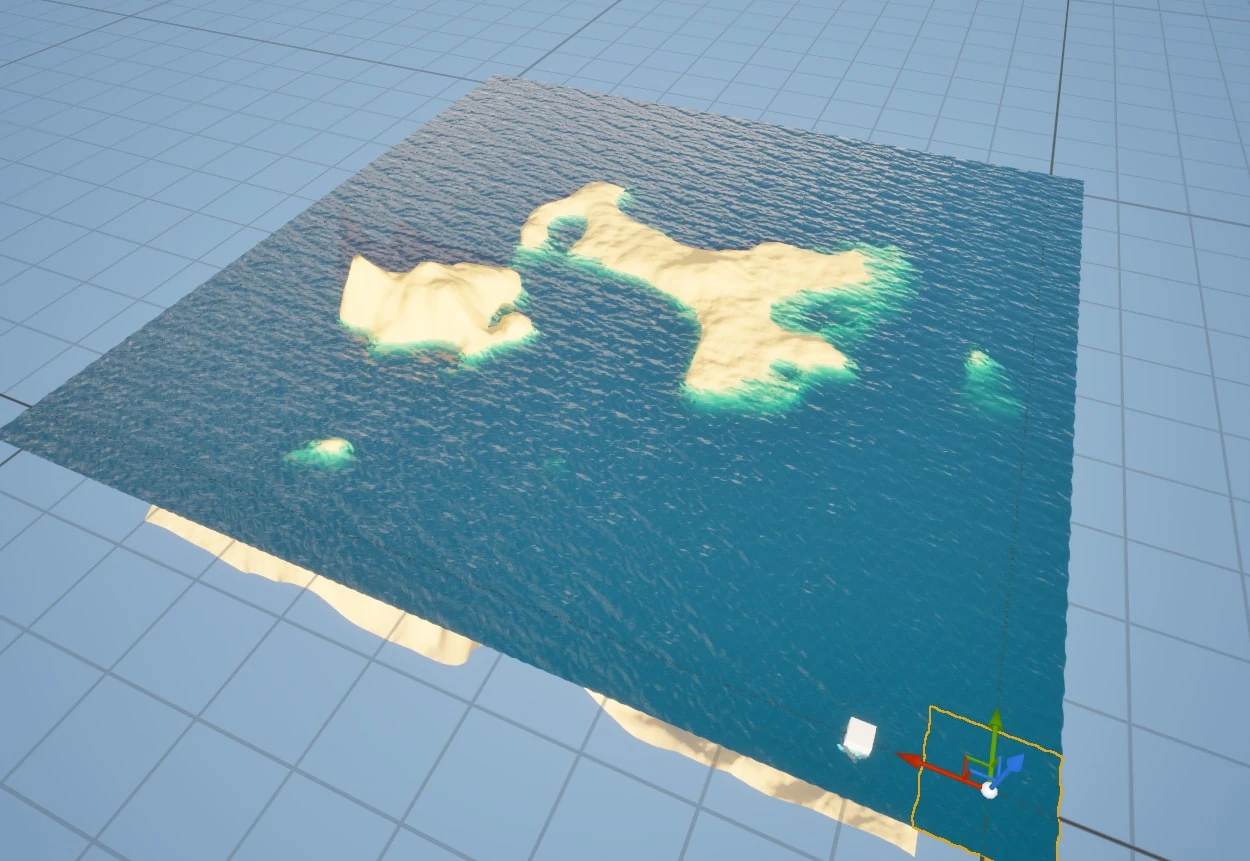
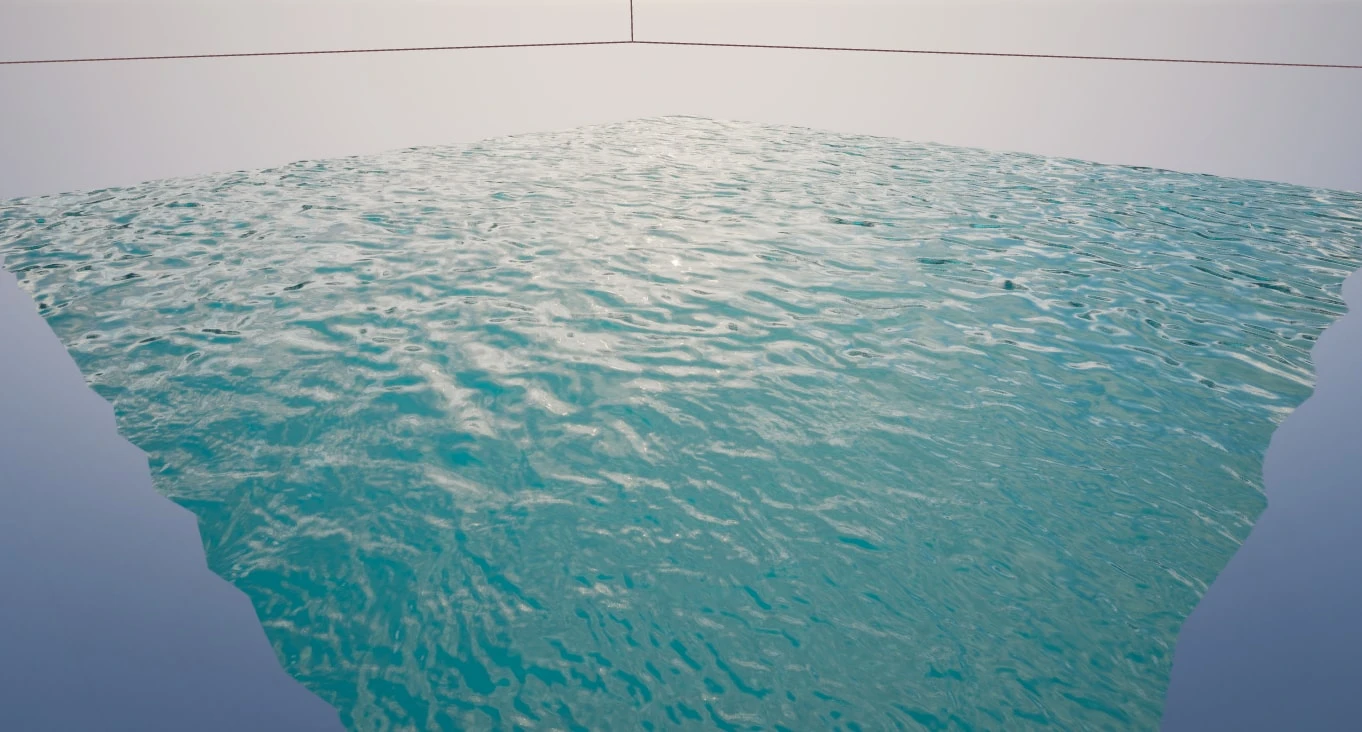
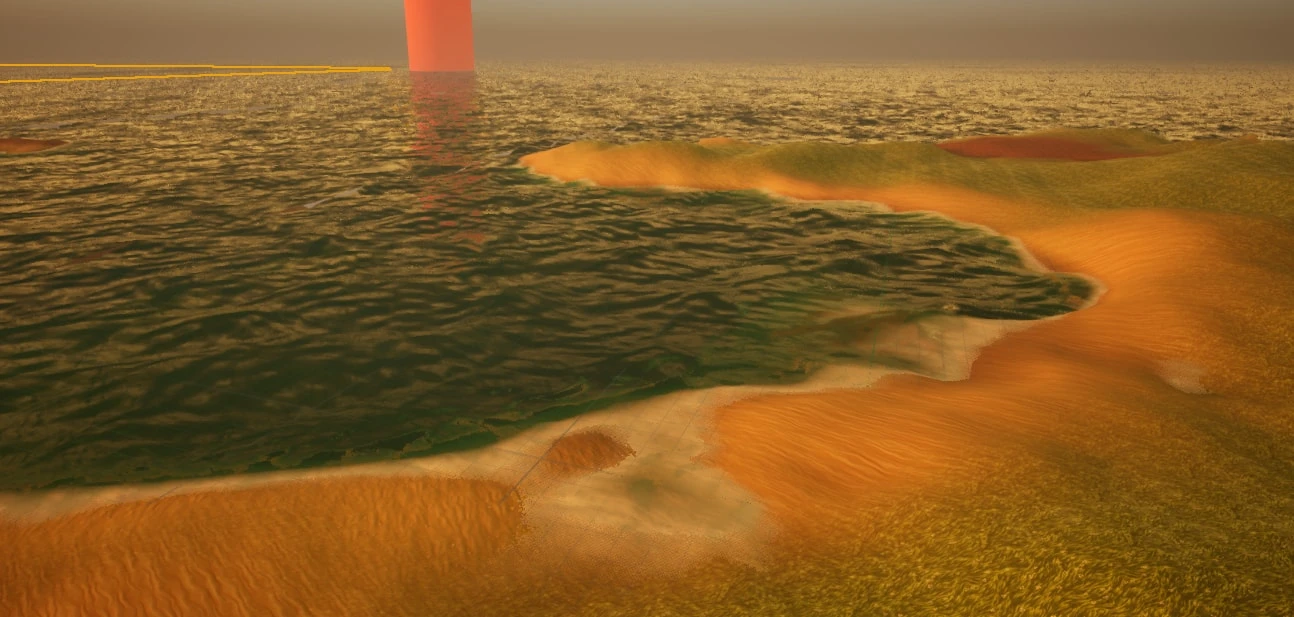
I made the ocean look stylised and easily customisable with foam, caustics and wet sand.
Making the water look convincing
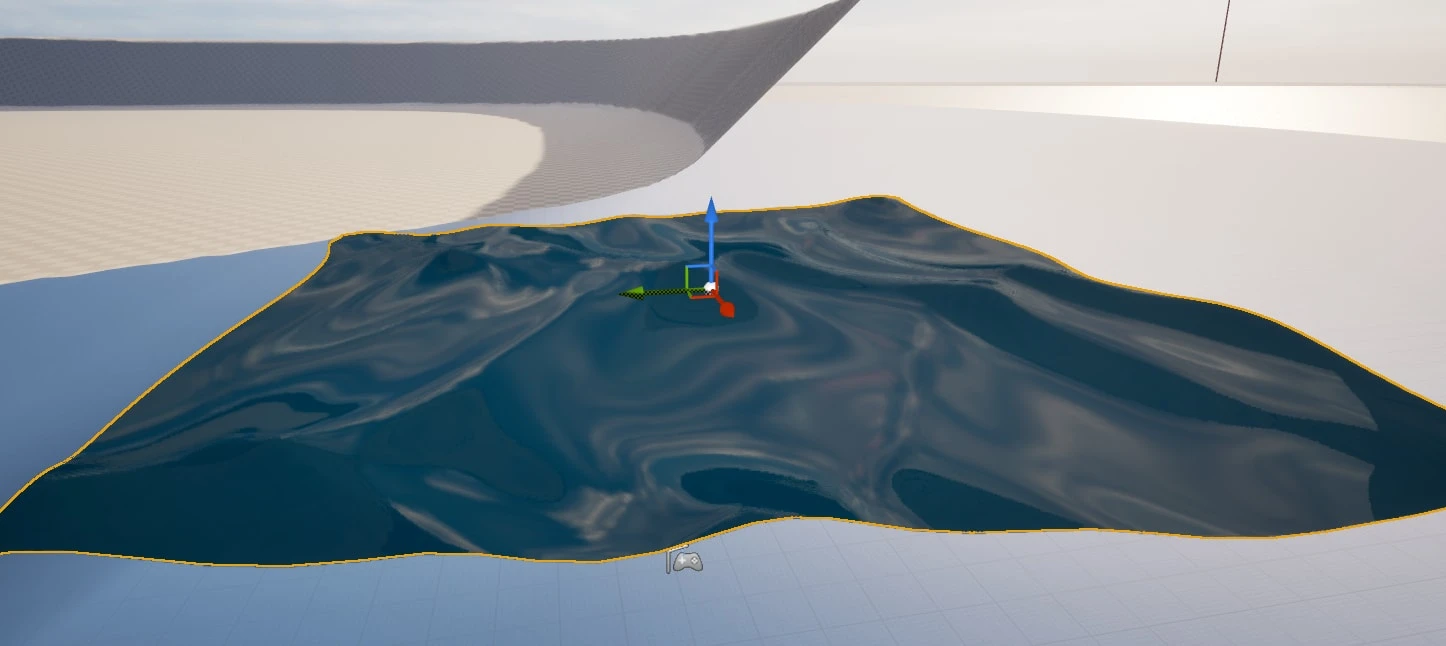
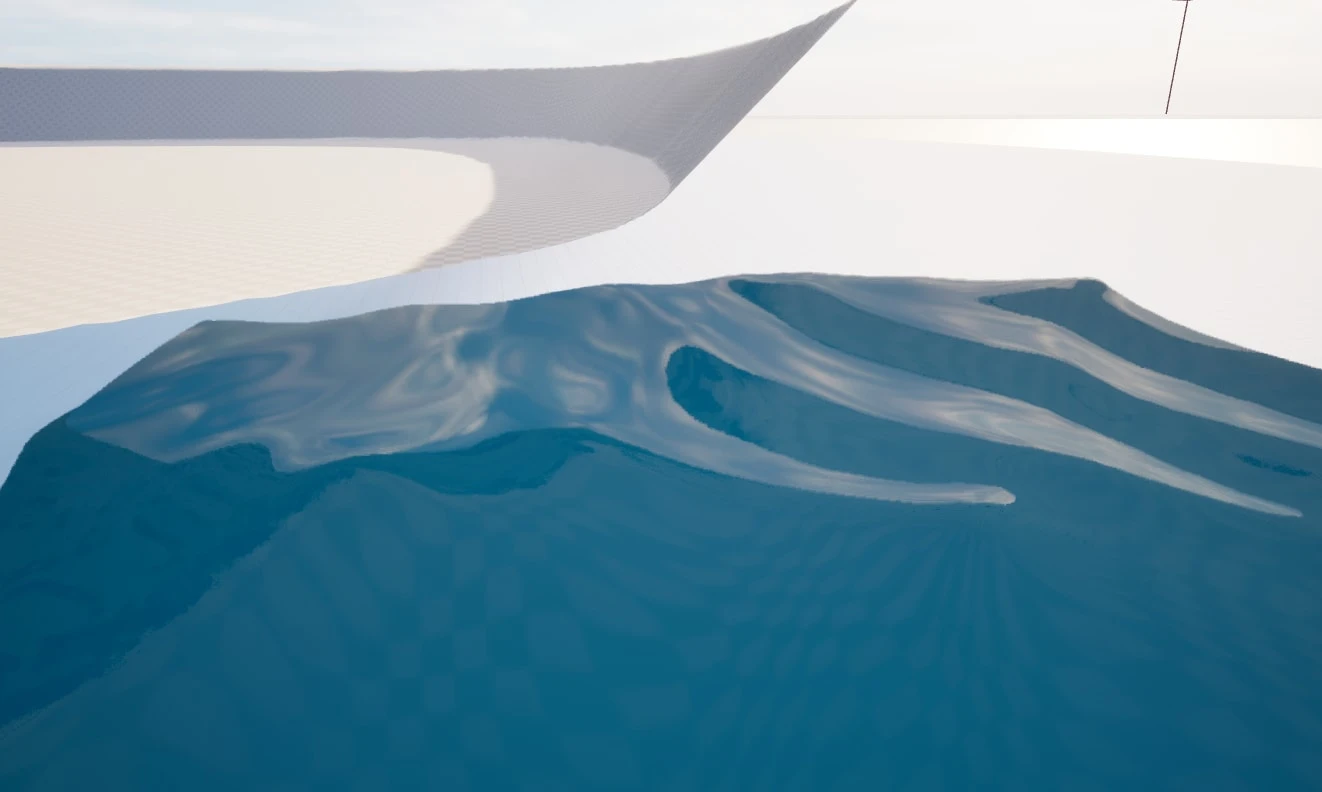
The first version of the ocean used a single tiling normal set and was particularly interesting. Following Marier’s article on water shaders (Marier, 2022), I moved the surface to Single Layer Water for proper scattering and absorption, then added fresnel-based reflection and roughness, refraction and pixel depth offset. Near and far 4-way panner chaos normal maps then broke up the reflections at both distances and did more to hide the tiling than anything else.
Foam and dithering
The foam comes from three sources:
- Distance fields - It reads the mesh distance fields Unreal already generates for Lumen, so anything placed in the water gets foam around it for no performance cost.
- Depth - It uses the difference between the water’s depth and the scene behind it to find shallow areas.
- Wave crests - It is driven by the mask the Gerstner node outputs, so it moves with the waves and highlights high points.
These are brought together in a single mask, which then drives a foam texture. The masks also use noise to help break up the edges. To avoid a hard edge where the water meets a very shallow area, the shader uses DitherTemporalAA into pixel depth offset to fade the foam out much more gently without needing real translucency, which would be more expensive.
Caustics
The caustics aren’t part of the water material. They’re a separate world-space decal material, placed as a decal volume over the seabed and based on Ben Cloward’s water caustics tutorial (Cloward, 2020).
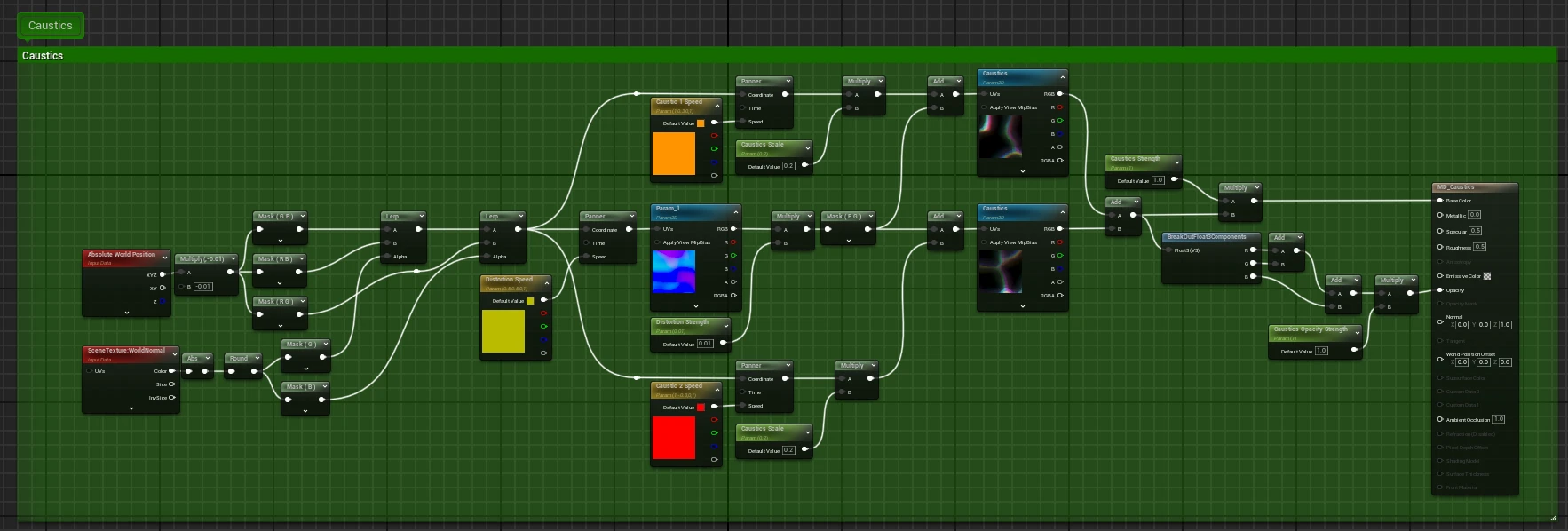
It projects from absolute world position rather than UVs, and uses the scene’s world normal to wrap to slopes even though it’s a top-down projection. Two caustic textures pan at different speeds and scales, both warped by a panning distortion texture, and are added together so the pattern never settles into an obvious loop.
The sum goes into base colour, scaled by a strength parameter, and also drives the decal’s opacity. The caustics started out emissive, which looked fine at midday but glowed through the water at sunset. In base colour they react to the scene’s lighting like everything else.
Wet sand
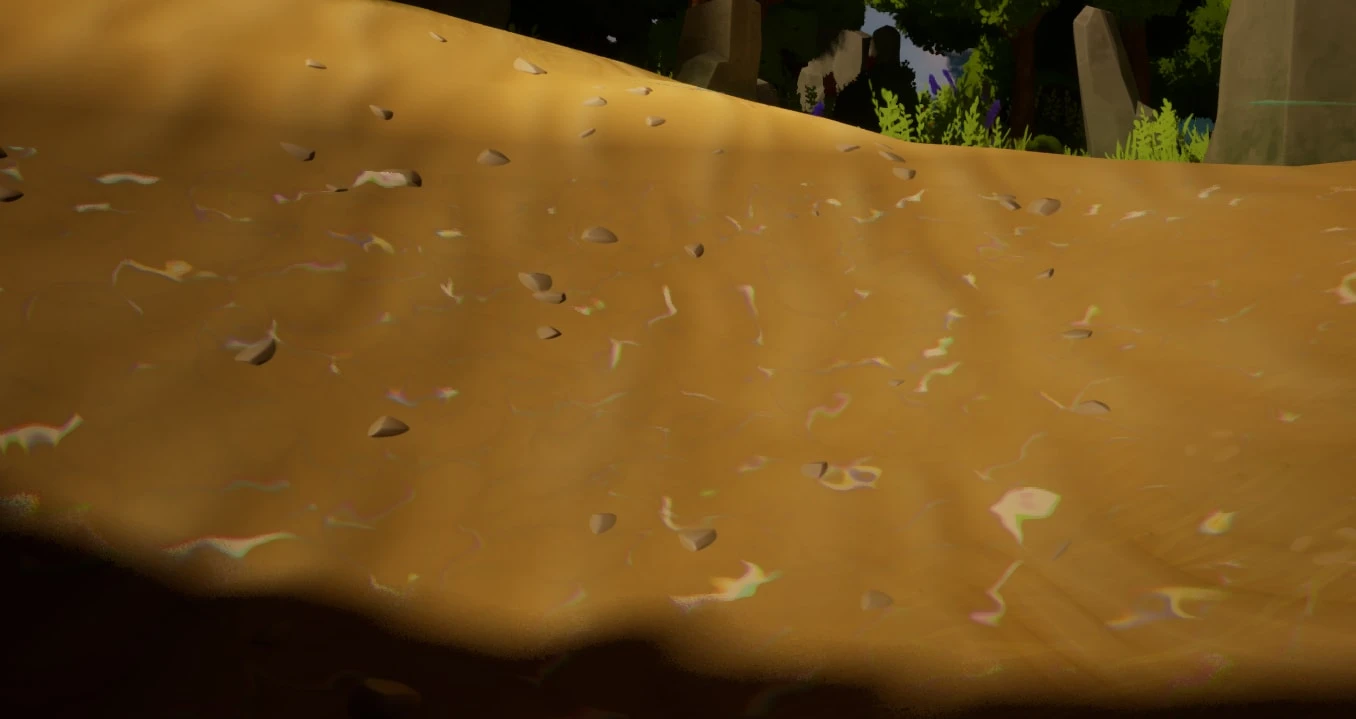
The wet sand is done in the landscape material, not the water. Below a set height, a sine of time moves a wet band up and down between a minimum and a maximum, so the waterline creeps in and out. Inside that band the base colour darkens and the roughness drops, making the sand darker and shinier at the same time, the way it gets when a wave pulls back over it.
Sources
Cloward, B. (2020). Water Caustics - UE4 Materials 101 - Episode 27. [online] YouTube. Available at: https://www.youtube.com/watch?v=9z6EMsoqLDY [Accessed 6 Feb. 2025].
The faked caustics implementation from Ben Cloward's shader series.
Marier, M. (2022). The formula for a good water shader for games in Unreal 4. [online] Medium. Available at: https://medium.com/@m.marier/the-formula-for-a-good-water-shader-for-games-in-unreal-4-ac72e5e86d49 [Accessed 28 Jan. 2025].
Useful guidance for SLW and other water shader tricks.